Home builders carry the most risk in a new home for one of the thinnest returns. To weather the coming downturn builders need to improve their operations in three ways. Lower the cost to build, build faster, and build with fewer paid trade days.
The order book has already turned. New-home sales, land lending and borrowing capacity are all down, and HIA is now commenting that fewer homes will start in 2027 once signed work is built out. On our reading, most builders have less than a year of work in hand to make the changes. Six levers do most of it, and two of them return cash within a quarter.
There is little room for error. Volume builders agree a price with the buyer, carry the cost of every trade and material until handover, and stand behind the home for years after it. For that, a builder typically keeps 3 to 7 cents in every dollar before tax (Master Builders WA), and we see similar results in the builders we work with.
In the builders we work with, the sales commission on a home is, in round figures, often about the same as the builder’s profit on it. Winning the sale is real work, but the builder carries the risk after it. Theft takes more. HIA warns that copper theft is “crippling” the sector, and the theft itself, and the locked fencing and video surveillance built to stop it, take a real share of a builder’s profit.

Figure 1. Anti-theft surveillance tower.
It is an industry worth getting right. Construction employs about 1.4 million Australians, around one worker in eleven, and is the country’s third-largest employer, with about 7% of GDP (ABS). When a builder fails, buyers lose deposits, trades and suppliers go unpaid, and the businesses that fit out new homes lose the orders.
That risk is rising again. Builders are busier than they have been in years, with about 95,000 houses under construction, but new-home sales fell 17.5% in the September quarter and cancellations rose to 13.6% (HIA).
The turn is already in the data
Housing runs as a pipeline. Land comes first, then a building contract and finance, and only then a slab.
- Land. Lending for residential land peaked in the December quarter 2025 and fell 13% over the next six months (ABS). In Victoria’s growth areas, gross lot sales in August were 31% below a year earlier (RPM, using Terralytics data)
- Contracts. New-home sales fell in four of the five months from May (HIA). The fall was steepest in Queensland, down 26.3%, and Victoria, down 23.3%
- Finance. The cash rate has risen four times in 2026, to 4.60%, and Westpac expects another rise in November. Borrowing capacity has fallen by about 9% this year (Canstar), and the average construction loan has shrunk two quarters running in seasonally adjusted terms (ABS)
The slowdown is reaching the retailers that furnish homes. Nick Scali’s Australian and New Zealand written orders fell 15% in the September quarter, and the AFR has tied both its profit warning and JB Hi-Fi’s weaker trading to the housing slowdown.
Fixed prices turn rising costs into losses
Most volume builders sell on fixed-price contracts, so much of the work now on site was priced before the cost and rate rises of 2026. House construction prices are about 51% above pre-pandemic levels (NHSAC), and trade prices rose 5.1% in the first half of this year alone (HIA).
The industry has seen where this leads. Rising costs on fixed-price work helped bring down Privium in 2021 and Porter Davis in 2023. Since 2023–24, between 700 and 820 residential building companies a year have entered external administration, more than double the 319 of 2021–22 (ASIC). Privium and Porter Davis had plenty of work. They ran out of cash building homes whose costs had risen well past the prices fixed at contract, and the ones that came through acted while they still had choices.
The builders who come through protect cash and treat time as margin
Protect the balance sheet
Cash and committed owners come first. Metricon lost money in FY23, and its owning family put in about $80m over that year to carry it through. Porter Davis, in the same market, could not raise further funding and went into liquidation. Metricon is now majority-owned by Sumitomo Forestry, whose group tops the latest HIA Housing 100.
Treat time as margin
A fixed price makes time the builder’s largest unpriced risk. Every week between signing and site start delays the cash and erodes the margin, and so does every week a house sits waiting once the slab is down. On 3 to 7 cents in the dollar, losing a point or two to inflation during delays takes a large share of the profit on a home. Delay has a second cost, because the longer a buyer waits, the more likely the buyer is to cancel.
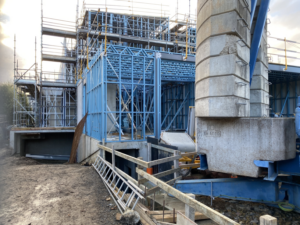
Figure 2. Medium-density project delivered late and over budget.
The recovery is coming
The downturn will pass. Australia is still building fewer homes than it needs, and the National Housing Supply and Affordability Council forecasts completions rising from about 179,000 in 2025–26 to about 219,000 by 2029–30, with the 1.2 million Housing Accord target reached around the end of 2030. Need sets the direction. Rates and credit will set the timing.
The best builders show how far the numbers can move
An Australian house takes about 255 days from start to completion (ABS). Single-storey homes come in faster than that average and doubles take longer. KB Home, one of the largest US volume builders, completes its built-to-order homes in an average of 99 days, and is working towards 90. The comparison is not exact, but the gap is too large to be a matter of definition.
Downtime is one factor, the days a house sits waiting for materials, for a trade that was not called forward, or for two trades stacked on top of each other. Paid trade days, which average 2.5 to 3 times the construction days, are the other. They improve when the home is designed for the build, when trades work on fewer designs and get to know them, when they arrive on time to a clear site with the materials there, when quality comes first so there are fewer call-backs and less rework, and when site managers solve problems on the day rather than later. KB Home closes that gap with discipline rather than capital, and it runs procurement and construction as one programme. In September it credited lower direct costs on started homes to rebidding its contracts, value engineering its products and a simpler design studio. After costs peaked in 2022, it took more than US$20,000 out of direct costs per home within a year.
I saw what that looks like from the inside. With KB Home and AvalonBay, at a previous firm, my team acted as reseller for key trades and materials and changed how work ran on site. When a trade arrived, the workface was ready and the materials were there. Materials costs fell 4 to 7% and trade costs 1 to 3.5%, which took 3 to 4% off the direct spend we managed.
Six levers do the work within a year
Argon & Co has worked with many Australian home builders, and today works with three of the ten largest. Across them, six levers move the cost to build, the days from contract to handover and the paid trade days. They are numbered in the order they return cash, and their timings overlap. The last three change how the business builds, and taking out downtime and designing for the build move all three at once.
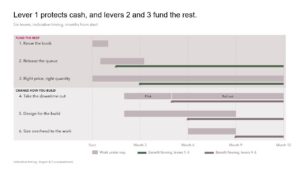
Figure 3. Six levers over twelve months, indicative timing. Lever 1 protects cash, and levers 2 and 3 fund the rest.
1. Know the book. First month
Stress-test every fixed-price job against today’s costs, rates and cancellation risk. Know which homes will lose money and which buyers are at risk, and build the cash plan around them before the bank asks.
2. Release the queue. Weeks two to fourteen
A home that is sold but waiting for site is margin not yet earned. Every week it waits, costs rise and the risk of cancellation grows. Clear the backlog first, then fix the release gate so build-ready homes move to site at the rate they are sold. Improving the build process to reduce build days and paid trade days is what gives the trade network the capacity to keep up.
3. Pay the right price for the right quantity. From month three
Typically we see much of a volume builder’s spend sitting off contract, or on contracts with no active commercial terms. Major material contracts have often lapsed years earlier and simply rolled over. Taking materials and indirect spend to market, category by category, starts paying within a quarter. For a public housing authority, Argon identified savings of 9% on more than A$1 billion of design, build and maintenance spend this way.
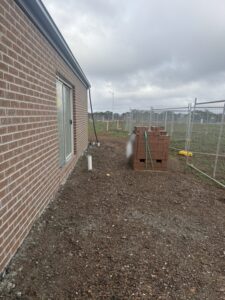
Figure 4. Excess pallet of bricks at a finished home.
Price is only half of it. A bill of quantities that matches the house stops surplus material going to the tip or walking off site. Work orders that match the effort stop the builder overpaying on piece rates, which erodes margin, or underpaying, which sends trades elsewhere or rushes the job. This second step takes four to six months, and it starts with data.
4. Take the downtime out. Pilot from month two, roll out by month twelve
Start homes only when every approval and selection is in place, and cap the work in progress. Schedule trades centrally, two to four weeks ahead, so every trade knows its next job. Reset the trade model, offering guaranteed volume in exchange for turning up on the slot at a fixed price. Give site managers the time and authority to solve problems on the day, not at the next site meeting. Pilot in one region, measure build days and paid trade days, then roll out.
In my experience, rework is a bigger drag on the schedule than on the budget. A trade called back to fix a defect is often not paid for the return visit, so the direct cost looks small, but the call-back pushes every trade behind it and the whole house waits. Quality gates that hold work until each stage passes catch the problem before the next trade arrives.
5. Design for the build. Months two to six
Much of the cost and time of a house is set at the drawing board, before a trade arrives on site. Fewer floor plans let crews repeat the same build. Designs that use standard dimensions, spans and components cut waste and trade days. Locking selections before start keeps variations from breaking the trade sequence mid-build.
Design also decides who can buy. A range designed around what buyers can finance today converts more of a shrinking pool.
6. Size overhead to the work. Months six to nine
Once the process is fixed, match spans, layers and back-office work to the volume the business will build. Use attrition and non-backfill where possible, so the business keeps the people it will need when volumes return. Cutting first and fixing the process later usually removes the capacity the recovery will need.
Run it as one programme
These levers connect. Knowing the book shows where cash is at risk, released starts and procurement savings fund the build reset, and a faster, simpler build makes the savings stick. The harder question is who has the capacity to make real change. Bain finds that only about one transformation in eight achieves its original ambition, and that the ones that succeed avoid overloading their top leaders. In a downturn, leadership time goes to the next crisis, so a programme carried on top of the day job rarely lands. Give it a dedicated team, hold a quarterly margin day to test or reset the plan as the market moves, and track the three numbers every week.
Use the window
Builders cannot control rates, land supply or buyer confidence. They can control the cost to build a home, the time it takes, and the paid trade days it needs. Our reading of the data, and what we see in the builders we work with, gives the industry less than a year before the slowdown reaches site. In our experience, that is enough time to move all three numbers, for the builders who start now.
If you want to see how your cost to build, build time, and paid trade days compare with the best in the industry, I would welcome the conversation.
Share:


Heavy Industry and Operations Partner

David Rotor