Most service businesses deliver more than what is specified in a contract or invoice. A dedicated contact, delivery outside the standard window, bespoke packaging, or emergency stock for a specific customer may all have been agreed for a good reason. Yet, in many cases, these services are never explicitly priced.
Over time, exceptions accumulate. Sales may agree to an additional service during a tender or contract renewal, while operations develops a workaround to deliver it. The cost is absorbed into the operating model, often without being formally documented or assigned to the customer. This results in a growing gap between what a business delivers, what it costs to deliver, and what customers actually pay.
The underlying issue is simple: sales owns revenue, operations owns cost, and neither side sees the full picture of what a single service costs and earns.
When exceptions become the standard
An individual exception may have a limited impact. However, challenges arise when exceptions become routine and gradually enter the cost base. Once that happens, their cost becomes part of the economics of the standard service.
This can create an unintended cross-subsidy. A customer looking for a straightforward service may effectively contribute to the cost of emergency stock, bespoke packaging or dedicated support negotiated by a different customer. Over time, this can distort the commercial proposition. Customers with simple requirements may find the standard price difficult to compete with, while customers who consume more service remain because they receive more value for the same price. As a result, the business can end up with a customer base that is increasingly expensive to serve.
Management may eventually conclude that a particular segment is simply too price-sensitive or unattractive. Yet the underlying issue may not be the segment itself. It may be the accumulation of unpriced services that has gradually increased the cost to serve.
Building a rate card for everything the business sells
A rate card starts with a clear service catalogue: an overview of every service the business provides provide, who receives them, what they cost to deliver and what customers currently pay for them. The answer to the last question is usually nothing, which is uncomfortable but easy to establish.
The more difficult question is the value of a service. What would a customer be willing to pay if it were priced separately? There is rarely a definitive answer, so organizations need to combine commercial insight, customer knowledge, competitive benchmarks and an understanding of what customers are willing to accept. A rate card is therefore more than a pricing tool. It creates transparency around what the business actually sells, what it costs to deliver and where it wants to compete.
This typically leads to three outcomes:
- Make it standard: Services that are widely requested and economically attractive can be incorporated into the standard proposition.
- Make it premium: Services that are relevant to a smaller group of customers, but generate sufficient willingness to pay, can be offered as premium options.
- Price or remove it: Services that are rarely requested and do not cover the cost can be charged at full cost or reconsidered altogether.
This creates a rate card: a clear overview of what the business sells, with a price attached to each service. From that point onwards, anything outside the standard proposition can be quoted and negotiated rather than automatically absorbed.
Aligning commercial decisions with operational reality
Building a rate card requires both operational and commercial input. Operations needs to quantify what it takes to deliver each service, including additional labor, planning complexity, inventory, handling and other operational consequences. Commercial teams need to establish what customers would be willing to pay and where removing a service could affect the customer relationship. Neither perspective is sufficient on its own. The cost of a service only becomes meaningful when considered alongside its customer value.
This becomes particularly important when an exception is already part of an existing customer relationship. Withdrawing a service that a customer has received for years is understandably difficult. The commercial team owns the relationship and has to manage the conversation, while operations sees the impact directly through manual workarounds, overtime, error rates and planning complexity. An established rate card gives a basis for decision-making. New requests can be assessed consistently: costed by the business, priced against the rate card and negotiated like any other service. What used to be an informal exception becomes a deliberate commercial decision.
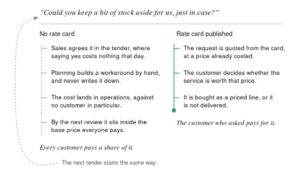
The same request, before and after the rate card exists.
The exercise is worth the discomfort. Once premium services are priced and reflected on the invoice, the standard proposition can return to a price that reflects the cost of standard service. This allows the business to compete more effectively on its core offering, while ensuring that customers who require additional services pay appropriately for the value they receive.
Maintaining the rate card through clear ownership
Creating a rate card is only the first step. Without clear ownership, the list will gradually become outdated as new customer requirements emerge and existing services evolve.
The organisation therefore needs a clear owner who can bring together the operational cost perspective and the commercial willingness-to-pay perspective, with the authority to add, price or remove services.
Two principles are particularly important:
- Cost new exceptions before they are agreed. Every new service should be assessed with the teams that will ultimately have to deliver it. A commitment made during a tender without understanding its operational impact can create structural margin leakage from day one.
- Review existing exceptions at contract renewal. This is the natural moment to revisit the services being provided, as pricing is already part of the commercial conversation. Adding, repricing or removing a service becomes a normal part of contract management rather than an exceptional discussion.
When this discipline is embedded, the benefits go beyond individual pricing decisions. Premium services begin to capture the customer value they create, the standard proposition becomes easier to price competitively and management gains a much clearer understanding of which customers and services genuinely create value.
Turning exceptions into commercial value
The objective is not to remove every exception. Some services are strategically important, strengthen customer relationships or create a genuine competitive advantage. The objective is to make deliberate choices about what the business provides, what it costs and what customers are willing to pay.
At Argon & Co, we help organizations understand the true cost to serve of their customer base and turn it into pricing decisions the business can defend. By bringing operations and commercial teams together, we help clients define the services they want to provide, establish the right pricing structure and create the governance needed to keep it relevant over time.
Share: