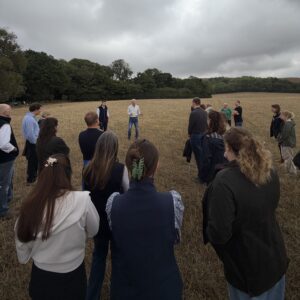
Last week, Argon & Co and the Food and Drink Federation (FDF) co-hosted an event at RJ Coward & Son’s Wood Farm in Wiltshire. The event brought together stakeholders from across the food and agriculture value chain to explore how regenerative agriculture can move from farm-level practice to practical supply-chain implementation.
Regenerative agriculture aims not only to minimise environmental harm, but also to restore soil health, biodiversity and wider ecosystem function. While approaches vary by farm and context, five commonly cited principles are minimising soil disturbance, keeping soil covered, maintaining living roots, maximising plant diversity and reintroducing livestock. These practices can improve soil structure, water retention and resilience to drought and flooding. This is increasingly important for food and drink companies seeking to strengthen resilience to climate change, protect crop yields from soil degradation and secure their long-term supply chains.
The morning provided an opportunity to see regenerative agriculture in practice. RJ Coward & Son shared experience of managing the transition in a live farming environment, including the choices, trade-offs and uncertainties involved. After the visit, Argon & Co facilitated a workshop focused on the questions manufacturers and retailers must address if regenerative agriculture is to become commercially viable and scalable.
Key takeaways
- Regenerative agriculture must be embedded in core business decisions
To become operational, regenerative agriculture cannot remain a standalone sustainability initiative or a series of isolated farm pilots. It needs to connect to category and sourcing strategies, supplier selection, demand planning, contracts, specifications, KPIs, budgets, legal review, marketing and board-level governance. Progress will depend on making it a cross-functional priority and part of everyday supply-chain decision-making - Businesses need to account for context rather than apply a one-size-fits-all model
Farms, crops, geographies, suppliers and businesses are all starting from different positions. Organisations should identify where they have the greatest combination of influence, potential impact and supply-chain relevance. This means prioritising specific ingredients or supply chains, working with farmers and suppliers to develop realistic transition pathways, and scaling from credible demonstrations. A common ambition is valuable, but implementation must reflect local conditions and farm-level realities - Farmers need commercial certainty and a robust business case
Regenerative practices can require investment, new capabilities and changes to farming systems, alongside tolerance for short-term disruption or variability. They must also be considered alongside competing land uses, income needs and food production priorities.
The commercial model is therefore as important as the technical intervention. Consumer willingness to pay should not be assumed to fund the transition. Longer-term relationships, clearer demand signals, transition finance or appropriate premiums, and greater flexibility in contracts, specifications and supplier KPIs will all be important. The business case may include improved supply resilience, reduced risk, continuity of supply and stronger brand value. - Credibility depends on common standards and evidence of outcomes
To build trust and scale adoption, businesses need clearer definitions, agreed baselines, comparable measures and credible assurance. Frameworks must also remain flexible enough to reflect different farming systems and local contexts.
Evidence should extend beyond carbon to include soil health, biodiversity, water, farm resilience and, potentially, wider health or nutritional outcomes. Independent research, transparent methodologies and appropriate accreditation can help prevent greenwashing, double counting and inconsistent claims. The principle should be to standardise what needs to be common while preserving flexibility where context matters - Collective action and government support are essential
No individual business or farmer can address these barriers alone. Collaboration across manufacturers, retailers, farmers, researchers, industry bodies, standards organisations and policymakers can reduce duplication, improve confidence and create a more level playing field. Shared frameworks, data, learning and accreditation will be important, as will government action on subsidies, incentives and policy conditions that support sustainable food production while protecting farm livelihoods.
The discussion highlighted that regenerative agriculture is no longer only a question of farming practices. The next challenge is to build the integrated business models, commercial mechanisms, evidence frameworks and partnerships needed to create impact at scale.
Thank you to everyone who attended and contributed, and to RJ Coward & Son for hosting. Further activities exploring how the food system can address these challenges will follow.
Share:


