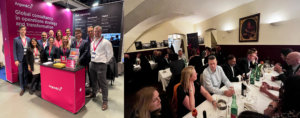
Recently, our Life Sciences teams from London, Paris, and DACH, returned to the LogiPharma conference in Vienna, Austria. LogiPharma is the largest global life sciences supply chain event, covering hot topics such as cost volatility, AI, rising tariffs and climate pressure.
Bringing together leaders from across the pharmaceutical industry, the conference once again provided a valuable platform for sharing perspectives, exploring new technologies, and discussing the future of supply chain transformation.
Client dinner
As part of our presence at the event, we hosted an exclusive client dinner ahead of the conference. Bringing together both clients and industry peers, the evening created an environment for open discussion and relationship building, with conversations reflecting some of the key themes that would emerge throughout the week, from AI adoption to supply chain resilience and the evolving role of partnerships.
Showcasing innovation
Across the conference, we were pleased to engage with attendees through both our demo and masterclass sessions.
On day one, Laurie Franquesa, Associate Partner, hosted a masterclass session with Norgine, focused on delivering meaningful cost improvement, while maintaining service, strengthening partnerships, and boosting resilience. The session explored how organisations can build the right capabilities, align teams, and sustain momentum through change, highlighting that while technology is a key enabler, it is ultimately people, structure, and leadership that determine success.
On day two of the conference, Mickail Voyiatzis, Chief Strategy Officer of Argon & Co’s Data and AI team delivered an engaging demo session focused on how organisations can apply Machine learning for practical forecasting in life sciences. The session focused on turning AI ambition into action, demonstrating how businesses can move beyond experimentation and start embedding AI into day-to-day decision making. The session garnered strong interest and discussion, reflecting the industry’s growing appetite for tangible, applied use cases. Together, these sessions provided complementary perspectives, and it was great to connect with so many attendees across both, as well as at our stand throughout the event.
Our teams attended various key speaker sessions and held conversations with various life sciences and supply chain leaders. Here are some of our key learnings:
From AI ambition to practical application
AI remained front and centre at this year’s conference, building on from last year’s conversations. However, the talking points regarding AI have clearly evolved.
While AI is now widely recognised as a critical lever for transformation, there remains a clear divide across the industry. Some organisations are advancing rapidly with sophisticated use cases, while others are still struggling with adoption.
A major shift this year was the focus on practical application:
- How to embed AI into day-to-day decision making
- Scaling AI adoption across organisations
- How to deliver value even with fragmented data
There was also strong interest in agentic AI and real-time decision making, highlighting the move from experimentation to more tangible outcomes.
There was a clear message that resonated with our teams: AI is only as effective as the data behind it. Fragmented systems and limited real-time visibility remain key barriers, reinforcing the need for strong data foundations.
Designing resilient supply chains in an uncertain world
Supply chain resilience was another dominant theme this year, but with a more advanced and practical lens compared to previous years.
Organisations are increasingly:
- Leveraging scenario planning and digital twins to prepare for disruption
- Focusing on N-tier visibility to better understand risk across the supply network
- Continuously reviewing and adapting their operating models to reflect changing geopolitical and market conditions
A key takeaway was that resilience is no longer a one-off initiative. It requires ongoing reassessment, as what works today may not be sufficient for the supply chains of tomorrow.
Relationships and partnerships:
Discussions throughout the event reinforced that organisations cannot tackle these challenges alone.
From technology implementation to capability building, the role of strategic partners is becoming vital for:
- Enabling faster AI adoption
- Helping organisations upskill internal teams
- Providing structure and momentum for transformation
There was a stronger focus this year on supplier relationships, particularly within procurement and supply chain. Strengthening collaboration across the supply chain is now seen as essential to improving both resilience and performance.
Bridging the data and capability gap
While interest in data and AI continues to grow, a clear gap remains between ambition and execution.
Many organisations are still:
- Working with fragmented data and systems
- Struggling to connect insights across functions
- Relying on historical data rather than real-time insight
This gap presents a significant opportunity and challenges for organisations looking to accelerate transformation at scale.
Logistics remains a core focus
As in previous years, logistics continues to be a major area of focus across the conference.
Topics such as cold chain, track and trace, and advanced logistics solutions were highly visible across exhibitors and sessions, highlighting the ongoing importance of ensuring product integrity and responsiveness within increasingly complex supply chains.
Looking ahead
LogiPharma 2026 showed that while the industry is making clear progress, there is still significant variation in maturity across organisations, particularly with regards to AI adoption.
We would like to thank everyone who joined us at our demo and masterclass sessions, visited our stand, and attended our client dinner. We look forward to continuing these conversations in the months ahead.
Share:


