A strategy used by many shippers to balance freight capacity during periods of fluctuating demand is to partner with truckload carriers that offer both traditional one-way for hire truckload services (which we will call “Over-the-Road” or OTR in this article) and dedicated fleet solutions. Other similar strategies combine 3PL dedicated fleet services with a brokerage solution as the conduit for tapping into the OTR market. The right model for a company can vary depending on your industry, service needs, and network configuration.
Best of both worlds
It is important to find a dedicated fleet partner that can flex capacity up and down during seasonal peak periods without passing extra costs back on to the shipper.
Many OTR truckload carriers not only run nationwide freight services but also offer dedicated fleet solutions that can expand shipper flexibility. Hybrid solutions that combine both a carrier’s OTR and dedicated fleet services ensure stable but flexible capacity, especially in constrained markets due to driver shortages, demand surges or other factors.
Benefits for Shippers
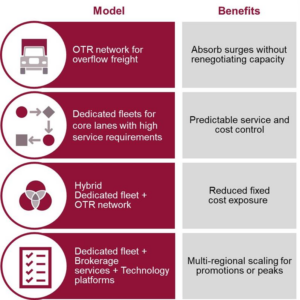
Using dedicated fleet solutions can help shippers achieve capacity stability, reliable service, cost discipline, operational efficiency, visibility and flexibility. Dedicated fleet solutions are ideal when reliability, consistency and cost control matter especially for repetitive lanes, high service requirements, and predictable freight volumes.
OTR truckload carriers are best when you need access to broad market capacity during periods of demand variability. OTR carriers can accommodate fluctuating volumes without the requirement of long-term commitments to tractors and trailers, so their service is usually ideal for irregular routes, seasonal surges, one-off loads, and long-haul OTR moves.
With a hybrid solution that combines the best of both dedicated and OTR transport services, shippers benefit from the stability of a dedicated fleet as well as access to an OTR carrier’s national network for overflow freight. These carriers can then provide the reliability of dedicated capacity along with the resource availability and flexibility of their broader OTR network and its existing pool of trucks, trailers and drivers.
An added benefit of a hybrid solution is having the flexibility to adjust fleet size and to remove dedicated assets during downturns when needed. It is simpler for an OTR carrier to move trucks and drivers that are no longer needed in a dedicated fleet back into their OTR network temporarily. This can help shippers avoid potential penalties related to fixed costs that may exist in traditional 3PL dedicated fleet agreements.
The table below summarizes common models and potential benefits for shippers:
Conclusion
By combining traditional dedicated fleet providers, 3PLs, and truckload carriers that offer both OTR and dedicated services, shippers can:
- Stabilize service levels
- Gain access to flexible surge capacity
- Improve fleet utilization and visibility
- Control freight costs
This multi-layered model is an effective approach for managing fluctuating freight volumes. By incorporating these transportation strategies, shippers can optimize their freight capacity utilization, improve efficiency, and keep their customers happy.
Visit Fred’s first article in this series at Dedicated vs OTR: Are you using the right model for the right freight?
Share:



Fred Miesch